Finding an ASU Clinical Preceptor in Alabama
Alabama is an AANP reduced practice state. Practice authority shapes the clinician's daily work, while ASU location rules, Edson approval, concentration fit, and the clinical calendar shape a usable student placement.
Tell us your concentration and city. It is free to ask, with no obligation.
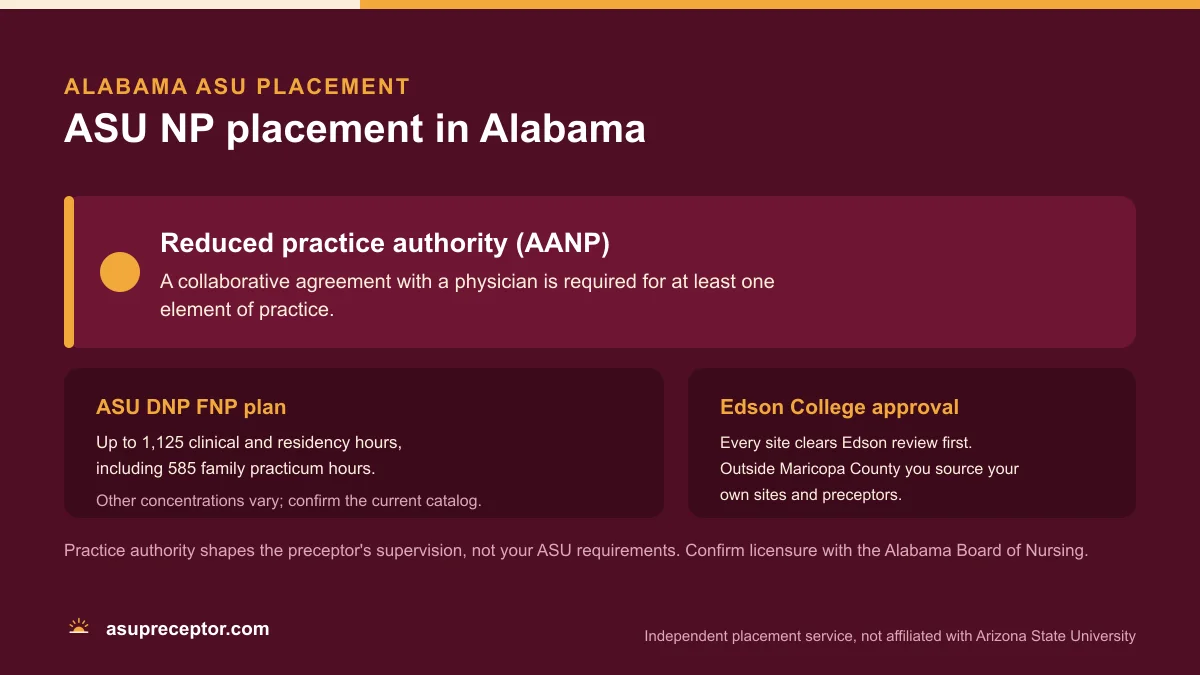
How reduced practice shapes NP practice
Alabama licenses NPs as Certified Registered Nurse Practitioners, or CRNPs, and requires a continuing collaborative agreement with an Alabama physician. Standard protocols organize consultation, quality review, authorized functions, and prescribing within that professional relationship.
A collaborating physician does not need to stand beside the CRNP for every visit. The CRNP may assess patients, develop diagnoses, order testing, and manage treatment within the protocols while the physician provides the required direction and availability. The agreement is part of the practice structure behind daily care.
For an ASU student, reduced practice does not prevent a useful rotation. It means the clinician's CRNP approval, collaboration, certification, site privileges, patient population, and teaching role should be clear before Edson review. The student remains supervised regardless of the preceptor's practice model.
Check the Alabama Board of Nursing, Advanced Practice before nomination
The Alabama Board of Nursing, Advanced Practice is the official source for license status, advanced practice requirements, renewal, and discipline in Alabama. Review the public record early. A clinic biography may omit a recent credential or authority change that matters to Edson's review.
State verification is one screening step. Edson separately evaluates the preceptor and site for the specific course. Ask whether the practice accepts outside students, who controls student access, and whether the clinician can provide the required patients, supervision, schedule, and evaluation.
- Verify the current license and population certification
- Confirm the clinician's daily patient mix and practice setting
- Identify the site contact responsible for student onboarding
Search Alabama by clinical market and course
Birmingham has Alabama's broadest group of hospital, specialty, primary care, and behavioral health settings. Huntsville adds a growing outpatient market. Montgomery, Mobile, Tuscaloosa, Auburn and Opelika, Dothan and the Wiregrass, the Shoals, and Gulf Coast communities provide additional search areas.
Rural and Black Belt counties have fewer clinicians, but a community practice may serve a broad population and offer strong continuity. The same small provider pool can fill early, so travel and scheduling should be resolved before a clinician enters the approval process.
A physical placement needs a commute the student can sustain for the entire course. A virtual proposal needs equal attention to patient location, supervision, technology, privacy, and site policy. Screening the population and setting first prevents a convenient but unusable clinician from consuming the approval window.
Apply the Edson placement rule for your location
ASU's Advanced Nursing Practice DNP uses different placement expectations inside and outside Maricopa County. Students outside Maricopa County identify the clinical sites and preceptors required for their plan, then submit them through the current Edson process. Edson must approve the site before any clinical work begins.
Within Maricopa County, clinical placements are assigned. Any student-proposed exception is controlled by current Edson instructions, so a local student should not treat an independent agreement with a clinician as an approved placement. The county distinction should be confirmed for the current course and cohort.
Outside Maricopa County, lead with a complete request that states the concentration, course, dates, weekly availability, population, and setting. Ask who authorizes students for the practice and what documents the clinician and site can provide. Keep a backup search active until Edson and the organization finish their required steps.
Plan concentration hours with the current catalog
The Advanced Nursing Practice DNP covers major concentration paths including family, psychiatric mental health, adult-gerontology, and women's health nurse practitioner preparation. For FNP, a current program plan commonly shows up to 1,125 clinical and residency hours, with 585 specialty practicum hours included. The current program of study, concentration, and catalog control.
Do not apply the FNP totals to another concentration. PMHNP, adult-gerontology, and women's health requirements vary, as can the course sequence associated with a student's catalog. Confirm the individual requirement before a preceptor is asked to cover a particular number of hours or patient encounters.
ASU holds institutional accreditation through HLC, and nursing accreditation is through CCNE. The student should separately verify current program eligibility and state requirements. A local search page provides logistics and practice context, not state authorization.
Connect hybrid study with physical and virtual options
Required Phoenix activities are part of ASU's hybrid Advanced Nursing Practice DNP. Students should account for those dates while planning local clinical work and should never assume the program can be completed as a fully online experience.
We preserve two service paths: physical placement sourcing and virtual preceptorship sourcing. Telehealth can be considered when Edson, the course, site, state, patient location, and supervision structure permit it. The student must confirm which activities and hours are accepted.
A candidate is screened around concentration fit, patients, schedule, and site. The student sees the match before making payment and pays only when the placement is secured. Service pricing remains on cost, and final clinical approval remains with Edson.
Request an ASU placement review for Alabama
If a student-led search is returning full schedules, wrong populations, or sites that cannot complete the Edson process, send a free placement review. Include the concentration, course, dates, city, travel radius, preferred clinical days, and whether a physical or eligible virtual route could work.
A strong candidate combines the correct clinician, patients, setting, teaching capacity, schedule, and organization. Continue following Edson instructions during sourcing, and wait for the required university and site decisions before beginning clinical activity.
Good to know
What is the NP practice category in Alabama?
AANP classifies Alabama as reduced practice. That category describes licensed NP practice. ASU students remain supervised, and Edson must approve a student-proposed site before clinical work.
Who identifies an ASU preceptor in Alabama?
Students outside Maricopa County identify required sites and preceptors. In Maricopa County, placements are assigned, with any exceptions controlled by the current Edson process.
How many clinical hours does the ASU FNP plan include?
A current FNP program plan commonly totals up to 1,125 clinical and residency hours, including 585 specialty practicum hours. Confirm the current program of study, concentration, and catalog. Other concentration totals vary.
Can an ASU Alabama placement include telehealth?
Possibly. Edson acceptance, the course, site, state, patient location, preceptor setup, and supervision plan must all allow it. Confirm what activities and hours can count before relying on a virtual route.
Do not leave your DNP to your own network
Tell us your concentration, your city, and your start term. We will come back with a placement plan and a realistic path through Edson's approval to your first clinical hour.