Your ASU DNP FNP preceptor, sourced and approved
If you live outside Maricopa County, ASU's Advanced Nursing Practice DNP with the Family Nurse Practitioner concentration makes you find your own clinical sites and preceptors, and the DNP program office does not guarantee a placement. We source an ASU-approvable family or primary-care preceptor in your area and shepherd the sites through Edson College approval, so your practicum hours, up to 1,125 in all, can start on schedule.
Tell us your concentration and city. It is free to ask, with no obligation.
Does ASU find your FNP preceptor for you?
No. If you live outside Maricopa County, ASU does not find your FNP preceptor, and the Doctor of Nursing Practice program office does not guarantee a placement. ASU arranges focused clinical experiences for students who reside in Maricopa County, but Edson College tells everyone else, in its own words, that "students residing outside of Maricopa County, Arizona, are responsible for identifying the required number of clinical sites in their area of residence and for identifying preceptors and sites willing to accommodate clinical rotations."
That policy puts the search on you: your city, your network, your outreach, for a doctoral program with a heavy practicum load. We run that search in your place and carry the sites you need through Edson's approval, which is the step where out-of-county students most often lose time.
How many clinical hours does the ASU DNP FNP require?
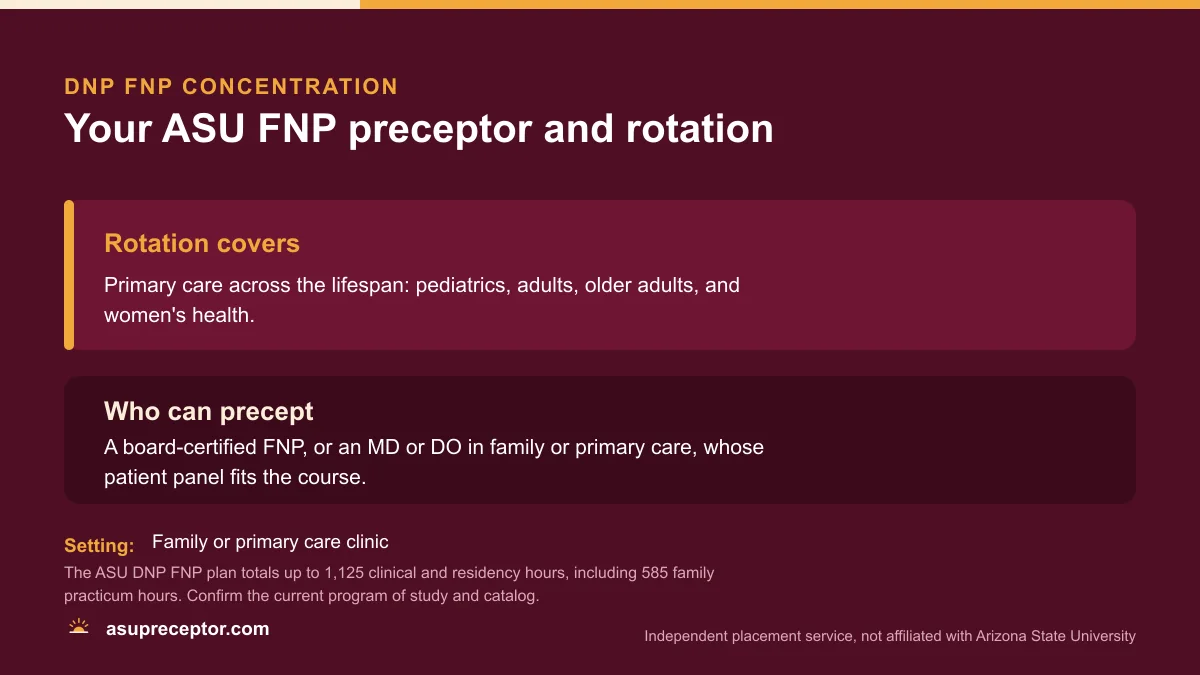
The ASU DNP Family Nurse Practitioner concentration requires up to 1,125 practicum hours, including 585 clock hours (13 credit hours) of family practicum, inside an 84 credit-hour program that ends with the DNP 707 applied project course. ASU notes that its 1,125 practicum hours exceed the AACN requirement, so a single missed or unapproved rotation can put a full term of a doctoral degree at risk. The table below summarizes the concentration as ASU publishes it.
| Item | Detail |
|---|---|
| Degree | Advanced Nursing Practice, DNP (Family NP concentration) |
| Total credits | 84 credit hours, including the DNP 707 applied project |
| Total practicum hours | up to 1,125 (ASU notes this exceeds the AACN requirement) |
| Family practicum | 585 clock hours (13 credit hours) |
| Clinical setting | community-based primary care, in your own region |
| Format | hybrid, with Downtown Phoenix intensives |
| Accreditation | CCNE (nursing), HLC (university) |
Confirm the exact figures for your catalog year against your current Edson handbook, since credit and hour counts can change between cohorts.
What clinical settings count for the FNP family practicum?
Family practicum at ASU is completed in community-based primary care, where you see patients across the lifespan under an approved preceptor in your own region. ASU places students in health profession shortage areas throughout the state, in both urban underserved and rural settings, which gives you a sense of the primary-care environments Edson recognizes. For out-of-county students that means your rotation needs to sit in a family or primary-care practice, a community clinic, or a comparable outpatient setting that Edson will approve, not a narrow subspecialty office that does not match the family scope.
When we evaluate a site for you, we are checking that its patient mix and provider scope will read as family primary care to Edson, not just that a provider is willing. A walk-in urgent care, a single-system specialty office, or a practice that only sees a narrow age band can leave gaps in the family competencies your rotation is meant to build. ASU's own placement of students across urban underserved and rural shortage areas is a useful signal of the breadth Edson expects, and it is the standard we screen against before you invest a term in a site.
Who can precept an ASU FNP student?
An ASU FNP preceptor must hold an active license in the relevant specialty and be approved by Edson College before your hours count. For the family concentration that generally means a board-certified family or primary-care provider, a physician or nurse practitioner, whose scope matches the family patient population. Preceptor eligibility rules are set by ASU and can vary, so we confirm each proposed preceptor against your program's current requirements rather than assume a match, and we do it before you commit so an ineligible preceptor never costs you a term.
In practice that means confirming the preceptor's license, national certification, and current scope before your name goes on any agreement, because a mismatch surfaced after the term starts is the costliest kind. A family or primary-care provider who carries a full lifespan panel is the cleanest fit; a provider whose practice has narrowed to one population may still work, but only if the rotation is structured to cover the family scope, which is a judgment we make with you rather than leave to chance.
How does the hybrid Downtown Phoenix format affect your FNP clinicals?
The ASU DNP is hybrid, not fully online, so your coursework runs online while the program requires in-person intensives at the Downtown Phoenix campus. ASU describes the format as requiring travel to campus for up to one week of orientation at the start of the program and two to three times per semester after that. Your 1,125 practicum hours, though, are logged locally with your approved preceptor, which is why your regional placement, not the Phoenix trips, is what determines whether your family practicum can begin on time.
For working nurses that split matters for planning: you can keep coursework online and around your schedule, but the orientation week and the two to three campus visits each semester need travel and time off booked in advance, and your practicum days have to fit your preceptor's calendar in your own city. None of that starts until your local site is approved, which is why we treat the placement, not the Phoenix trips, as the gate on your timeline.
How do we place your ASU FNP preceptor?
We work as an independent NP preceptor matching service: we source an ASU-approvable family preceptor and the clinical sites your concentration needs, verify the credentials and specialty fit against ASU's rules, and shepherd the documentation through Edson's approval so your family practicum starts on schedule. You pay only once your preceptor and site are confirmed, never the preceptor, and we never promise an approval decision that belongs to ASU. Tell us your city and start term and we will map the search.
Sources: ASU DNP FNP degree page, ASU Edson College clinical placements, and AACN Essentials.
Good to know
Does ASU place FNP students outside Maricopa County?
No. Those students identify their own clinical sites and preceptors, and the DNP program office does not guarantee a placement. Edson College approves the sites you bring, which is the gap we fill.
How many hours is the ASU DNP FNP?
Up to 1,125 practicum hours, including 585 clock hours (13 credit hours) of family practicum, within an 84 credit-hour DNP that ends with the DNP 707 applied project.
Is the ASU DNP FNP fully online?
No. It is hybrid, with online coursework, in-person Downtown Phoenix intensives up to one week for orientation and two to three times per semester, and clinicals in your own region.
Is ASU Edson College CCNE accredited?
Yes. The baccalaureate, master's, and DNP nursing programs are accredited by the Commission on Collegiate Nursing Education, and the university is accredited by the Higher Learning Commission.
Are you affiliated with ASU?
No.
Do not leave your DNP to your own network
Tell us your concentration, your city, and your start term. We will come back with a placement plan and a realistic path through Edson's approval to your first clinical hour.