ASU DNP clinical hours, explained
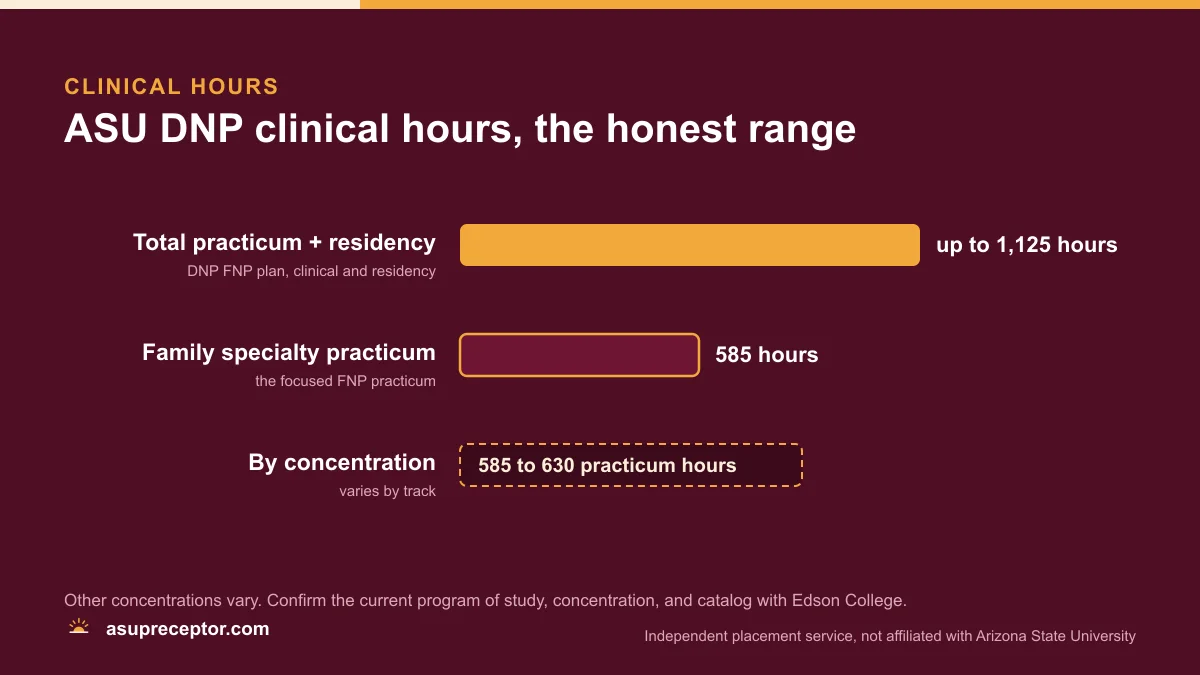
The ASU Advanced Nursing Practice DNP requires up to 1,125 practicum hours across its nurse practitioner concentrations, with the focused practicum running from 585 to 630 clock hours depending on the track. This page lays out the hours by concentration, how they compare to the AACN minimum, where the DNP 707 applied project fits, and who has to secure the sites.
Tell us your concentration and city. It is free to ask, with no obligation.
How many clinical hours does the ASU DNP require?
Every ASU DNP nurse practitioner concentration requires up to 1,125 practicum hours, and the focused, specialty-specific portion ranges from 585 clock hours (13 credit hours) for the family, adult-gerontology, and psychiatric tracks to 630 clock hours (14 credit hours) for women's health. The post-master's FNP graduate certificate is a shorter, 22 credit-hour path that still carries 585 clock hours of family practicum. The table compares them side by side as ASU publishes them.
| Program | Total credits | Total practicum | Focused practicum |
|---|---|---|---|
| DNP Family NP (FNP) | 84 | up to 1,125 | 585 clock hours (13 cr), family |
| DNP Psychiatric Mental Health NP | 85 | up to 1,125 | 585 clock hours (13 cr), psychiatric |
| DNP Adult-Gerontology Primary Care NP | 84 | up to 1,125 | 585 clock hours (13 cr), community |
| DNP Women's Health NP | 84 | up to 1,125 | 630 clock hours (14 cr), community |
| FNP graduate certificate | 22 | practicum-focused | 585 clock hours (13 cr), family |
Always confirm the exact number for your concentration and catalog year against your current ASU handbook.
How do ASU's practicum hours compare to the AACN minimum?
ASU's 1,125 practicum hours exceed the national minimum. The American Association of Colleges of Nursing sets the floor for a practice doctorate at a minimum of 1,000 post-baccalaureate practicum hours, and ASU states plainly that its program exceeds the AACN requirement. The practical takeaway for out-of-county students is that there is no slack: at more than 1,000 hours, losing a term to a site that arrives late or fails approval is expensive in both time and tuition.
That comparison is worth keeping in front of you when you plan. Because the floor for a practice doctorate is high and ASU sits above it, there is no version of this program where clinical hours are a light lift, and no schedule where a term lost to a placement problem is easily absorbed. Building your practicum plan around the full hour count from the start, rather than the minimum you hope to get away with, is the safer read.
What is DNP 707 and how does the applied project fit the hours?
DNP 707, titled Disseminating Evidence to Advance Best Practice in Health Care and Health Policy, is the applied project course that anchors the doctoral end of every ASU NP concentration and sits inside the 84 credit-hour program, 85 for psychiatric mental health. It is the scholarly project work that distinguishes a DNP from a master's-level NP path, and it runs alongside your clinical practicum rather than replacing it, so your practicum hours and your applied project both have to be planned into your timeline.
It also shapes how you sequence your program. The applied project is a multi-term effort that builds toward implementation and dissemination, so it competes for the same calendar as your clinical rotations. Students who map both the practicum hours and the DNP 707 milestones onto their timeline early avoid the crunch of trying to finish a doctoral project and log hundreds of clinical hours in the same stretch.
Who has to secure the clinical sites and preceptors?
It depends on where you live. ASU arranges focused clinical experiences for students residing in Maricopa County, but tells everyone else, in its own words, that "students residing outside of Maricopa County, Arizona, are responsible for identifying the required number of clinical sites in their area of residence and for identifying preceptors and sites willing to accommodate clinical rotations." Because most online and out-of-state students fall outside Maricopa County, the working reality is that you build the preceptorship and ASU approves it. That is the search we run for you, end to end.
The distinction that trips students up is that approval is not sourcing. Edson reviewing and clearing a site is a real service, but it only acts on what you bring, so if you have not found a site, there is nothing to approve. That is why the out-of-county reality is best treated as two jobs, the search and the approval, and why handing the search to a service changes the math on whether your hours start on time.
How does the hybrid Phoenix format affect your hours?
The DNP is hybrid, not fully online. Coursework runs online, but ASU requires in-person intensives at the Downtown Phoenix campus, up to one week for orientation plus two to three times per semester. Your practicum hours themselves are logged in your own region with an approved preceptor, so the campus trips and your clinical hours are separate commitments, and it is your local placement that governs whether the hours can start.
For planning purposes, treat the campus intensives and your clinical hours as separate line items on your calendar. Orientation and the two to three visits per semester need travel booked ahead; your practicum hours need a preceptor's schedule and an approved site in your own city. Neither substitutes for the other, and it is the local, approved placement that gates when your hours can begin.
What happens if faculty require additional supervision?
If your faculty decide you need extra support, your clinicals can move to Phoenix. ASU's policy states that if, during the program, faculty determine a student needs additional supervision for clinical progress, the student must complete clinical experiences in the Phoenix area. For an out-of-county student that is a real downside worth planning around, and it is one more reason to secure a strong, clearly approvable local placement from the start.
Sources: ASU DNP FNP degree page, ASU Edson College clinical placements, and AACN Essentials.
Good to know
How many clinical hours does the ASU DNP require?
Up to 1,125 practicum hours across the NP concentrations, with focused practicum of 585 clock hours for family, adult-gerontology, and psychiatric, and 630 clock hours for women's health.
Does the women's health track require more hours?
Yes. Women's health requires 630 clock hours (14 credit hours) of focused practicum, against 585 clock hours (13 credit hours) for the other concentrations.
Is the ASU DNP fully online?
No. It is hybrid, with online coursework, Downtown Phoenix intensives, and clinicals completed in your own region.
Who approves my clinical sites?
Edson College of Nursing and Health Innovation must approve your sites and preceptors before you begin any clinical experience.
Is ASU Edson College CCNE accredited?
Yes. The nursing programs are accredited by the Commission on Collegiate Nursing Education, and the university by the Higher Learning Commission.
Related
Do not leave your DNP to your own network
Tell us your concentration, your city, and your start term. We will come back with a placement plan and a realistic path through Edson's approval to your first clinical hour.