Finding an ASU Clinical Preceptor in Hawaii
Hawaii is an AANP full practice state. Practice authority shapes the clinician's daily work, while ASU location rules, Edson approval, concentration fit, and the clinical calendar shape a usable student placement.
Tell us your concentration and city. It is free to ask, with no obligation.
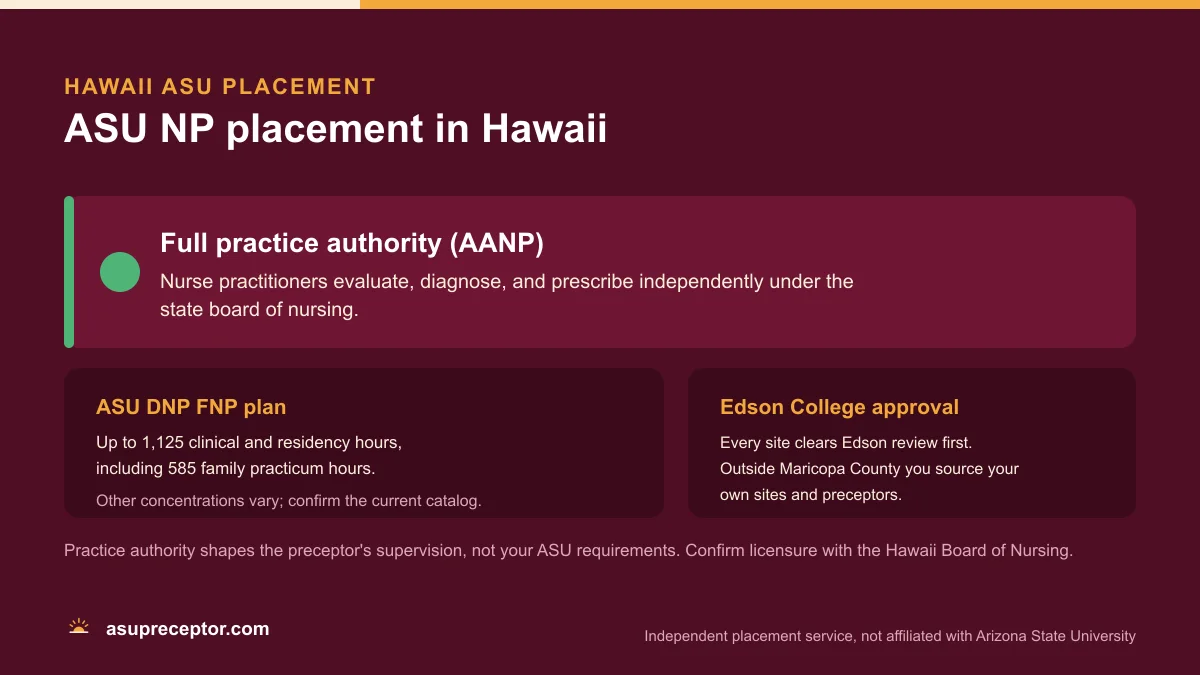
How full practice shapes NP practice
Hawaii NPs may evaluate, diagnose, order and interpret tests, and manage treatment under the Hawaii Board of Nursing without a required physician collaboration agreement. The state permits independent and NP-led practice across the islands.
Hawaii treats APRN licensure and APRN prescriptive authority, called APRN-Rx, as connected but distinct credentials. The Board record helps a student confirm what authority a prospective preceptor holds. Independent status broadens possibilities but does not prove course fit.
ASU students remain supervised at Edson-approved sites. The clinician must hold the appropriate population focus, see suitable patients, and have time to teach. Travel or temporary housing should wait until the required school and site steps are complete.
Search Hawaii by clinical market and course
Oahu has the greatest provider concentration around Honolulu, Pearl City, Kapolei, and Kaneohe. Hilo and Kona anchor Hawaii Island, Kahului and Wailuku anchor Maui, and Lihue anchors Kauai. Neighbor island providers may serve wide areas through only a few organizations.
Oahu offers more sites and more student competition. Neighbor islands have a thinner provider pool, so one system's teaching policy may shape the whole term. Inter-island rotations require flight, housing, and backup plans that work for every scheduled clinical period.
A physical placement needs a commute the student can sustain for the entire course. A virtual proposal needs equal attention to patient location, supervision, technology, privacy, and site policy. Screening the population and setting first prevents a convenient but unusable clinician from consuming the approval window.
Check the Hawaii Board of Nursing before nomination
The Hawaii Board of Nursing is the official source for license status, advanced practice requirements, renewal, and discipline in Hawaii. Review the public record early. A clinic biography may omit a recent credential or authority change that matters to Edson's review.
State verification is one screening step. Edson separately evaluates the preceptor and site for the specific course. Ask whether the practice accepts outside students, who controls student access, and whether the clinician can provide the required patients, supervision, schedule, and evaluation.
- Verify the current license and population certification
- Confirm the clinician's daily patient mix and practice setting
- Identify the site contact responsible for student onboarding
Apply the Edson placement rule for your location
Placement responsibility changes at the Maricopa County boundary. An ASU student outside Maricopa County identifies prospective sites and preceptors, while Edson evaluates whether they meet the program and course. The student may not begin clinical activity until Edson approval and any site onboarding are complete.
In Maricopa County, Edson assigns placements, and current Edson policy governs any exceptions. Students should follow the present process rather than asking a local clinic to reserve a slot independently. A clinician's interest is useful information, but it does not override the assignment system.
For an outside-county search, organize the patient population, concentration, setting, dates, and schedule before outreach. A precise request helps the provider and site decide whether they can host. It also gives Edson clearer information when the proposed placement enters review.
Connect hybrid study with physical and virtual options
The ASU program is hybrid, with required Phoenix activities. It should not be planned as a fully remote degree. Standard clinical work ordinarily needs physical patient access at an approved site, even when other learning uses online tools.
Our service sources physical placements and virtual preceptorship routes. Telehealth may support supervised experience only when the course, site, state, patient location, preceptor setup, and Edson acceptance all allow it. Confirm what can count before relying on a virtual schedule.
We screen candidates for concentration, population, setting, dates, and teaching interest. The student sees the proposed match before payment and pays only when a placement is secured. Pricing belongs on the cost page, while Edson retains every academic approval decision.
Plan concentration hours with the current catalog
Hour planning should begin with the exact ASU concentration and catalog. The current FNP plan commonly publishes up to 1,125 clinical and residency hours, including 585 specialty practicum hours. Those figures must be confirmed through the current program of study, concentration, and catalog rather than treated as permanent totals.
The Advanced Nursing Practice DNP also includes PMHNP, adult-gerontology, and women's health NP preparation, and their totals vary. Population requirements, clinical courses, and residency components should be checked individually. A clinician should be asked to support the exact course, not the full degree in the abstract.
Edson nursing programs are accredited by CCNE, while ASU's institutional accreditation is HLC. Students should also confirm current eligibility and state-specific program conditions. Neither accreditation nor a state page replaces that individual check.
Request an ASU placement review for Hawaii
If a student-led search is returning full schedules, wrong populations, or sites that cannot complete the Edson process, send a free placement review. Include the concentration, course, dates, city, travel radius, preferred clinical days, and whether a physical or eligible virtual route could work.
A strong candidate combines the correct clinician, patients, setting, teaching capacity, schedule, and organization. Continue following Edson instructions during sourcing, and wait for the required university and site decisions before beginning clinical activity.
Good to know
What is the NP practice category in Hawaii?
AANP classifies Hawaii as full practice. That category describes licensed NP practice. ASU students remain supervised, and Edson must approve a student-proposed site before clinical work.
Who identifies an ASU preceptor in Hawaii?
Students outside Maricopa County identify required sites and preceptors. In Maricopa County, placements are assigned, with any exceptions controlled by the current Edson process.
How many clinical hours does the ASU FNP plan include?
A current FNP program plan commonly totals up to 1,125 clinical and residency hours, including 585 specialty practicum hours. Confirm the current program of study, concentration, and catalog. Other concentration totals vary.
Can an ASU Hawaii placement include telehealth?
Possibly. Edson acceptance, the course, site, state, patient location, preceptor setup, and supervision plan must all allow it. Confirm what activities and hours can count before relying on a virtual route.
Do not leave your DNP to your own network
Tell us your concentration, your city, and your start term. We will come back with a placement plan and a realistic path through Edson's approval to your first clinical hour.